


Urban parking lots often create friction and wasted space. They feature manual barriers, scrap signs, and constant unauthorized occupancy. Consequently, managers have long treated lots as chaotic blind spots. Yet, a quiet revolution transforms these asphalt zones dramatically. Smart parking locks convert passive spaces into active, intelligent nodes.
By combining low-profile hardware with digital networks, they enforce order efficiently. Moreover, these devices do more than lock; they optimize space management. Ultimately, smart locks turn chaotic lots into high-efficiency resource hubs.
1. The Aesthetic of “Invisibility”: Design That Merges with the Ground
The first step in reconstructing a parking lot is removing the “visual noise” of traditional management tools. Conventional mechanical locks are often bulky, rusted, and physically obstructive, creating a cluttered and potentially hazardous landscape.
The Flat-Profile Revolution
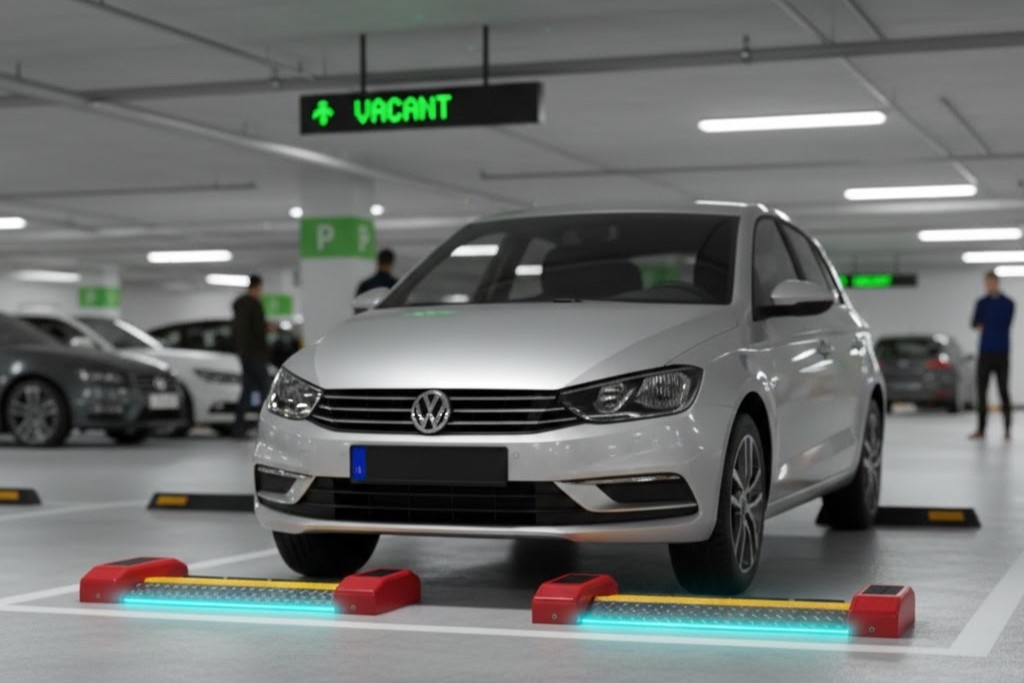
Modern smart parking space locks prioritize a “flattened” design philosophy. When in the lowered position, the device sits only a few centimeters above the ground, often featuring a streamlined, arc-shaped casing that integrates seamlessly with the floor’s texture.
-
Visual Harmony: By eliminating the upright, jagged metal of old-world locks, the parking lot regains a clean, expansive horizontal line. The “lock” effectively becomes invisible to the eye until it is needed.
-
Safety and Durability: The flat design ensures that vehicles can pass over the unit without risk of tire damage or chassis scraping. Furthermore, the high-strength pressure-resistant casing—often rated to withstand several tons of weight—ensures that the “invisible power” remains intact even in high-traffic environments.
2. From “Locks” to “Nodes”: The Functional Transformation
To understand why a smart lock enables “self-management,” one must look beyond its physical arm. Its true power lies in its identity as a communication node within an IoT (Internet of Things) ecosystem.
The Bluetooth and APP Integration
Traditional locks require a human being to physically step out of the car, find a key, and manually unlock the barrier. The smart parking space lock removes this friction.
-
The “Senseless” Experience: Utilizing Bluetooth sensing or mobile APPs, the lock “recognizes” the authorized user as they approach. The arm lowers automatically, providing a seamless transition from transit to parking.
-
The Power of Remote Control: Beyond individual use, property managers can control these units via a centralized dashboard. This turns a scattered collection of parking spots into a unified, programmable network.
Redefining Space Rules
A smart lock doesn’t just block a car; it enforces a rule. Whether it is a VIP spot, a pre-paid reservation, or an electric vehicle charging bay, the lock ensures that the intended use of the space is the only use of the space. This “Silent Guard” reduces the need for security patrols and eliminates the verbal confrontations that occur when spaces are misused.
3. The Manager’s Secret Weapon: Turning a “Dumping Ground” into a “Resource Bank”
For property owners, the most significant shift is the transition from a “Fixed Asset” to a “Liquid Resource.”
Dynamic Allocation and Scheduling
In a traditional lot, a reserved spot sits empty and wasted when the owner is at work. With smart parking space locks, that spot can be “shared” or reallocated during off-peak hours.
-
On-Demand Distribution: The management system can remotely open “reserved” spots for visitors or temporary guests, then “re-lock” them before the primary tenant returns.
-
Monetization of Idle Time: By integrating the locks with a billing platform, property managers can turn every minute of a parking bay’s life into potential revenue, maximizing the ROI of the square footage.
Data-Driven Logistics
Because every movement of the lock is logged, managers gain a “God’s eye view” of their parking lot. They can see occupancy rates, peak usage times, and turnover speeds. This data allows for the continuous optimization of the parking lot’s “functional order,” ensuring that the space evolves with the needs of its users.
4. The Silent Guard: Safety and Reliability in the Digital Age
A system of “self-management” is only as good as its reliability. Smart locks are engineered to be the most resilient part of the parking infrastructure.
-
Anti-Collision Technology: If a vehicle accidentally hits the lock arm while it is raised, an internal sensor triggers an alarm and allows the arm to “give” slightly to prevent damage to the car or the internal motor. Once the obstruction is gone, the arm automatically resets.
-
Weather-Proof Resilience: Designed for the outdoors, high-end smart locks feature IP67-rated waterproofing. Whether in the scorching summer heat or under a layer of winter ice, the internal lithium battery and motor continue to operate, ensuring the “order” is never broken by the elements.
-
Energy Efficiency: Utilizing low-power Bluetooth protocols, a single charge can often power a lock for 6 to 12 months, making it a low-maintenance solution for large-scale deployments.
5. Redefining the Aesthetics of Modern Living
We often underestimate how much the “visual order” of a parking lot affects our perception of a building. A lot filled with mismatched cones and chains feels neglected; a lot equipped with sleek, automated smart parking space locks feels premium, secure, and modern.
-
For Residential Communities: It provides residents with a sense of “owned” luxury and peace of mind.
-
For Commercial Hubs: It signals to clients that the business values efficiency and high-tech convenience.
-
For Smart Cities: It represents the “last mile” of urban digitalization, where even the ground we park on is part of a larger, intelligent narrative.
6. Conclusion: The Elegance of Control
The smart parking space lock is far more than a tool to prevent unauthorized parking; it is the architect of a new kind of urban order. Merging the physical and digital worlds, it allows parking spaces to “manage themselves,” liberating human managers from the drudgery of manual enforcement.
When we remove the visual clutter and replace it with invisible, intelligent power, the parking lot is transformed. It becomes a clean, efficient, and aesthetic asset that respects the user’s time and the property’s value. In the silent rise and fall of a smart lock arm, we see the future of urban space—an elegant “resource bank” that works in harmony with the rhythm of the city.