

In the urban landscape of the 21st century, space is the ultimate currency. Yet, for at least eight to ten hours every day, millions of private parking spaces sit idle while their owners are at work. Simultaneously, nearby commuters circle the blocks in frustration, fueling congestion and carbon emissions. This is the “Parking Paradox”: a massive surplus of supply that cannot meet a massive surge in demand due to a lack of access and trust.
The solution isn’t building more concrete; it is the “Uber-ization” of existing assets. However, the sharing economy requires more than just an app; it requires a physical gatekeeper. This is where automatic parking lock solutions transition from simple security devices into critical “Transaction Executors.” By allowing a parking spot to “go to work” while the owner is away, the smart parking lock becomes the silent but essential participant in a new era of resource optimization.
1. The Physical Foundation of Trust: Why Sharing Needs a Lock
The sharing economy—whether it’s Airbnb for homes or Uber for rides—relies on the seamless transfer of access. In the world of parking, this transfer is notoriously difficult. How do you let a stranger use your driveway or reserved spot without being there to hand over a key or move a cone?
The “Permission Gatekeeper”
A standard manual lock or a simple “No Parking” sign is a static barrier. It cannot distinguish between a friend, a paying guest, or a trespasser. Automatic parking lock solutions change this by introducing “Dynamic Authorization.”
-
Physical Enforcement: The lock provides a tangible, rugged barrier that prevents unauthorized vehicles from occupying the space.
-
Digital Verification: Through IoT (Internet of Things) connectivity, the lock acts as a bridge between the digital payment and the physical world. It only lowers when the “Gatekeeper” confirms a valid transaction.
2. From Idle Asset to “Active Employee”: The Workflow of Sharing
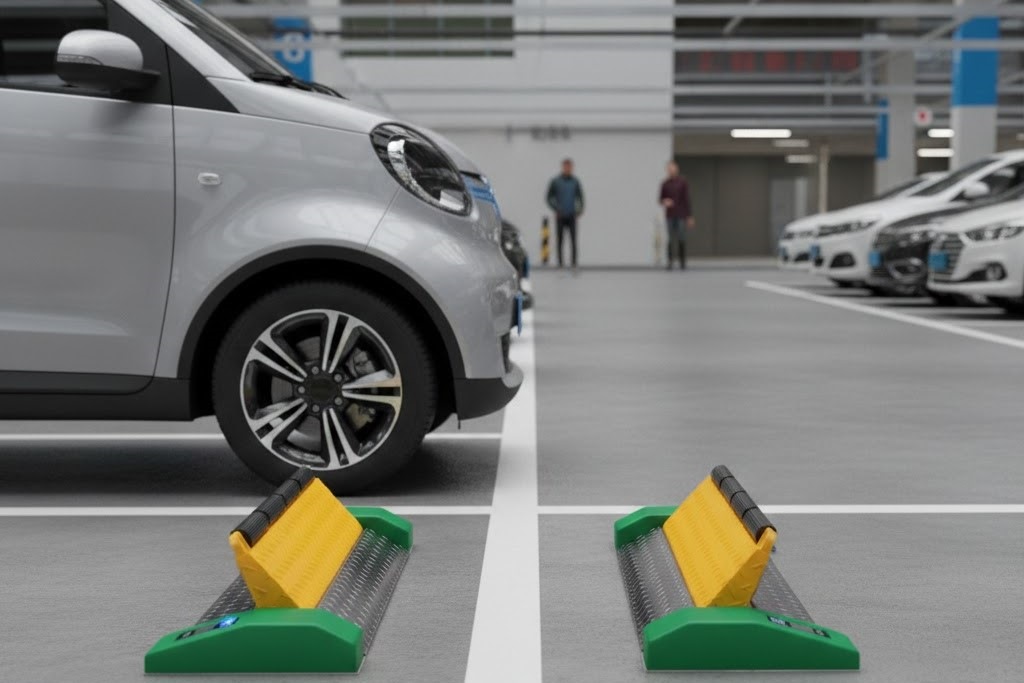
The magic of a smart parking lock lies in its ability to automate the entire lifecycle of a rental transaction without human intervention.
Phase 1: Scheduling and Visibility
The owner sets their “Working Hours” via a smartphone app—for example, Monday to Friday, 9:00 AM to 5:00 PM. The automatic parking lock solutions then broadcast the spot’s availability to a cloud-based network. The parking spot is now “on the clock.”
Phase 2: The Digital Handshake
A commuter near the owner’s office sees the available spot on their map. They book it and pay digitally. At that exact moment, the cloud grants the tenant a “Temporary Digital Key.”
-
Seamless Entry: As the tenant’s car approaches, they trigger the lock via Bluetooth or NB-IoT through the app. The arm lowers gracefully. The “Silent Coach” has executed the trade.
Phase 3: Automated Exit and Reset
Once the rental period ends and the car leaves, ultrasonic or infrared sensors within the lock detect the departure. The lock arm automatically rises, securing the spot for the owner’s return or the next tenant. The transaction is closed, the funds are transferred, and the asset has “earned its keep.”
 3. The Technology of Reliability: Engineering the Perfect Gatekeeper
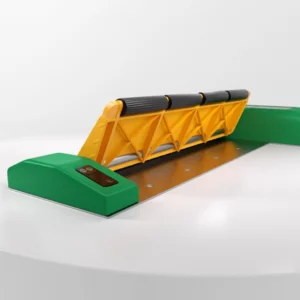
For a parking lock to facilitate a sharing economy, it must be “set and forget.” It cannot fail, it cannot run out of battery unexpectedly, and it must withstand the harsh realities of the outdoor environment.
-
Ultra-Low Power Consumption: Professional automatic parking lock solutions utilize advanced power management, allowing the internal battery to last for 6 to 12 months on a single charge, or even indefinitely with solar-supplemented lids.
-
Heavy-Duty Resilience: Sharing means high frequency. The internal motor and gearing must be rated for tens of thousands of cycles. Furthermore, the outer shell is typically pressure-resistant—capable of withstanding 2 to 5 tons of weight if a vehicle accidentally rolls over it.
-
Anti-Collision Intelligence: If the lock arm meets resistance (like a car bumper) while rising, it must immediately stop and sound an alarm. This protects the tenant’s vehicle and the lock’s internal mechanics, maintaining the “Trust” that is central to the sharing model.
4. Economic and Social ROI: The “Elegant Evolution” of Resources
Moving from “Ownership” to “Access” creates a ripple effect of benefits for the owner, the user, and the city.
-
Passive Income for Owners: A parking space in a prime downtown area can generate significant monthly revenue. The smart lock pays for itself within months, turning a monthly maintenance cost into a profit center.
-
Reduced Traffic for Cities: Up to 30% of urban traffic is caused by drivers looking for parking. By making private spaces “publicly accessible,” automatic parking lock solutions reduce “circling” and lower urban CO2 emissions.
-
Property Value Enhancement: For property managers and developers, installing smart locks throughout a residential complex increases the “tech-appeal” of the building and provides a structured way to manage visitor parking.
5. Future Outlook: The Integration of Autonomous Vehicles
As we move toward a future of self-driving cars, the automatic parking lock becomes even more critical. An autonomous vehicle doesn’t have a human to move a bollard or navigate a complex gate. It needs to “talk” to the parking space.
-
V2X Communication: Smart locks will eventually communicate directly with vehicle onboard systems. Your car will “handshake” with the parking lock, which will lower automatically as the car docks. In this scenario, the parking lock is the final “docking station” in a fully automated transport network.
6. Conclusion: The Power of Quiet Participation
The most successful technologies are the ones we stop noticing. The smart parking lock doesn’t demand attention; it doesn’t shout. It simply stands guard, waiting for the digital signal to facilitate a move.
By adopting automatic parking lock solutions, we are doing more than just securing a patch of asphalt. We are participating in the “Elegant Evolution” of resources. We are teaching our parking spaces to “work,” transforming them from dead zones into vibrant, revenue-generating nodes of the modern city. In the sharing economy, the smart lock is the silent partner that makes the impossible—seamless, trusted, automated sharing—a daily reality.